
As the global focus on climate action intensifies, businesses, governments, and individuals are increasingly exploring ways to reduce their environmental impact. One of the most prominent mechanisms in this endeavor is carbon offsetting — and at the heart of it lies the concept of carbon credits. But what do these terms really mean, and how do they work in practice?
Let’s break it down.
What is Carbon Offsetting?
Carbon offsetting is a method used to compensate for greenhouse gas (GHG) emissions by investing in environmental projects that reduce or remove an equivalent amount of carbon dioxide (CO₂) or other GHGs elsewhere. It operates on the principle that emissions are a global problem — CO₂ released in one part of the world can be offset by reducing emissions in another.
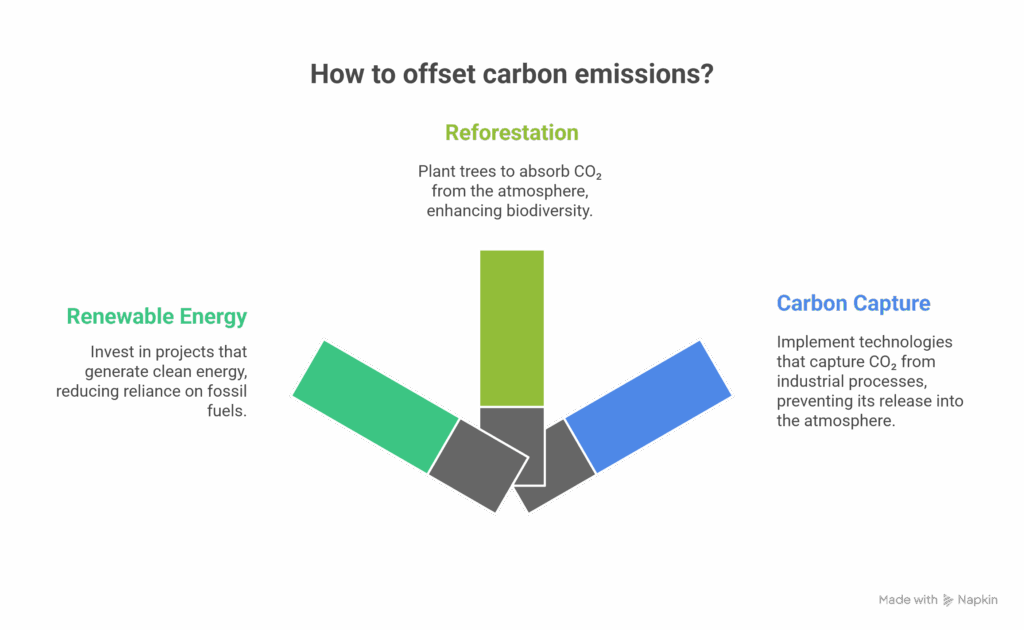
For example, if a company emits 1,000 tons of CO₂ annually, it can offset this by funding renewable energy, reforestation, or carbon capture projects that reduce or remove 1,000 tons of CO₂ elsewhere.
What are Carbon Credits?
Carbon credits are tradable certificates representing the right to emit one metric ton of carbon dioxide or its equivalent in other greenhouse gases. They are issued by certifying bodies when projects successfully reduce or remove emissions.
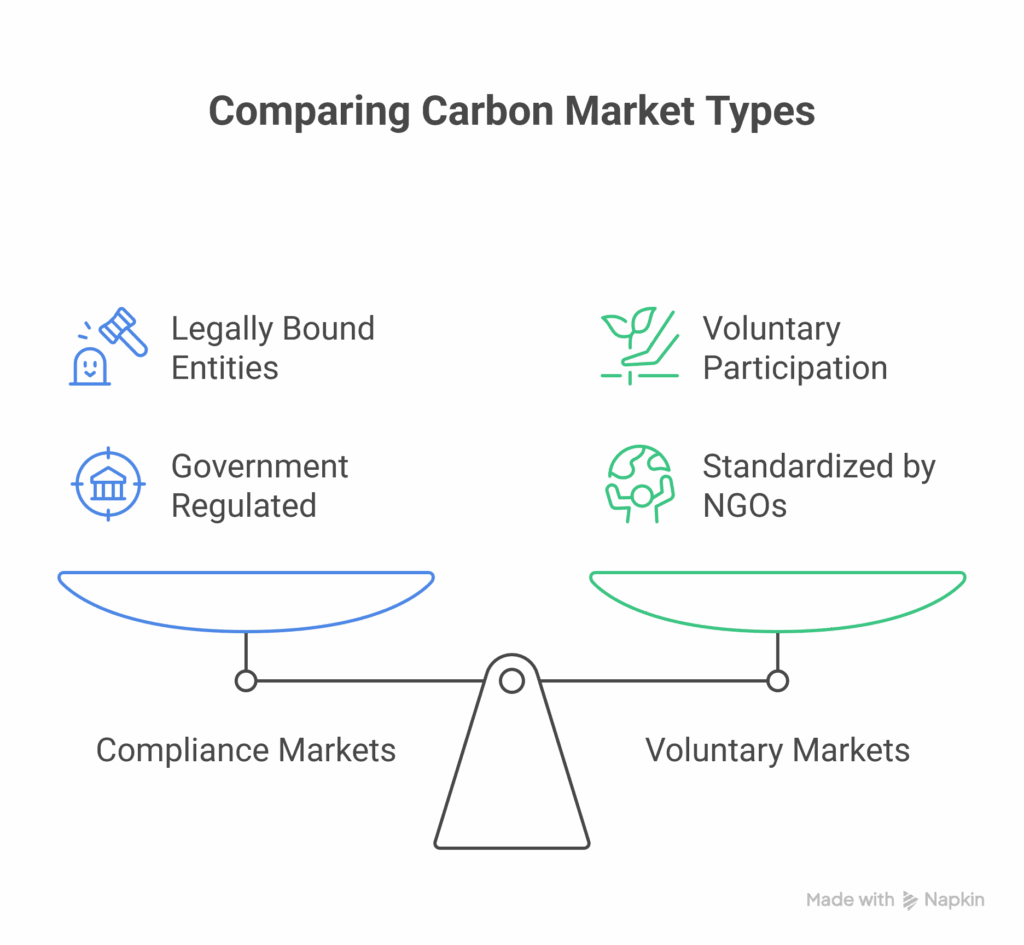
There are two main types of carbon markets:
1. Compliance Markets
These are regulated by governments or international agreements (e.g., the EU Emissions Trading System). Entities are legally bound to cap their emissions and can trade carbon credits to meet their targets.
2. Voluntary Markets
These allow businesses, NGOs, and individuals to voluntarily offset their carbon footprint. Voluntary carbon credits are issued by standards such as Verra’s Verified Carbon Standard (VCS), Gold Standard, or the American Carbon Registry.
How Does Carbon Offsetting Work?
Here’s a simplified process:
- Measurement: An organization calculates its carbon footprint.
- Reduction: It reduces emissions internally where feasible.
- Offsetting: For residual emissions, it buys carbon credits from verified offset projects.
- Certification: These projects are certified to ensure that the emissions reduction is real, additional, measurable, permanent, and verifiable.
Common offset projects include:
- Renewable energy (solar, wind, hydro)
- Reforestation and afforestation
- Methane capture from landfills or farms
- Clean cookstove distribution
- Blue carbon (mangrove restoration)
Why are Carbon Offsets and Credits Important?
- Climate Neutral Goals: Helps companies meet net-zero or carbon-neutral targets.
- Global Impact: Supports sustainability in developing regions.
- Cost-Effective: Often more economical than reducing all emissions internally.
- Brand Reputation: Demonstrates environmental responsibility to stakeholders and customers.
Challenges and Criticism
Despite their potential, carbon offsets face scrutiny:
- Quality Control: Not all projects deliver promised reductions.
- Permanence: Forest-based offsets may not be permanent due to risks like wildfires.
- Greenwashing: Companies may rely solely on offsets instead of reducing their actual emissions.
Thus, offsetting should be a complement — not a substitute — to direct emission reductions.
India’s Role in Carbon Markets
India has emerged as a key player in the carbon offset landscape:
- The country hosts a large number of carbon offset projects under the Clean Development Mechanism (CDM).
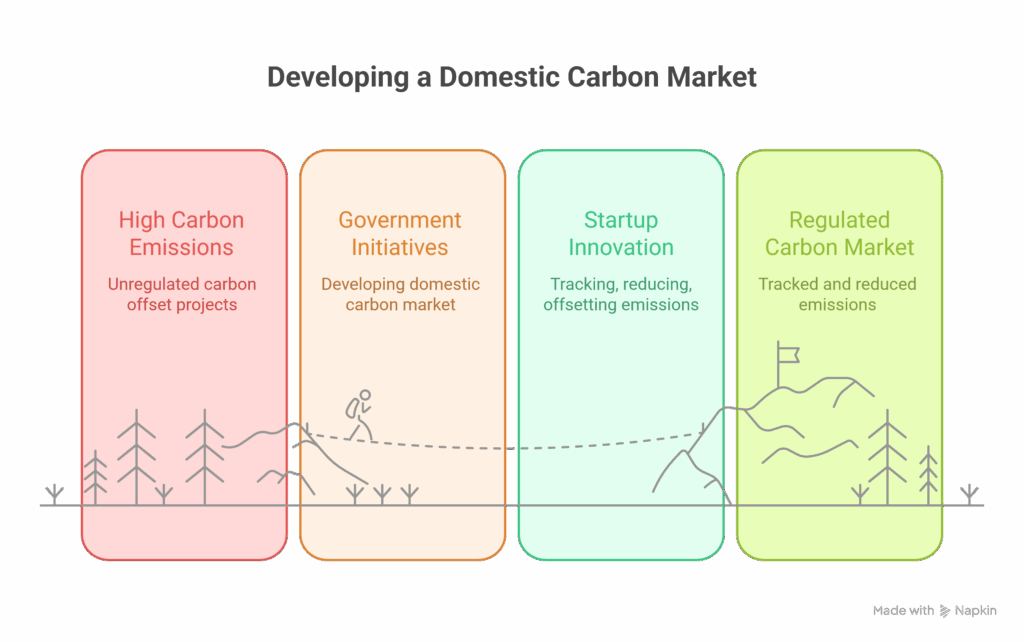
- The Indian government is developing its own domestic carbon market, with both voluntary and compliance components.
- Startups and platforms are emerging to help businesses track, reduce, and offset their carbon emissions effectively.
Conclusion
Carbon offsetting and carbon credits are powerful tools in the fight against climate change. When used responsibly and transparently, they enable entities to take climate action while supporting global sustainability initiatives.
However, the emphasis must remain on emission reduction first, and offsetting as a final step toward achieving net-zero goals.
In the journey to a low-carbon future, understanding and leveraging carbon credits is not just an option — it’s a necessity.
Do you want to explore how your organization can start its carbon offsetting journey or engage in India’s emerging carbon markets? Contact EcoStrateGix to learn how we can help you build a credible, sustainable climate strategy.